

The Story
Bengaluru-based deep-tech startup BioCompute is shutting down its local laboratory operations and relocating to San Francisco.
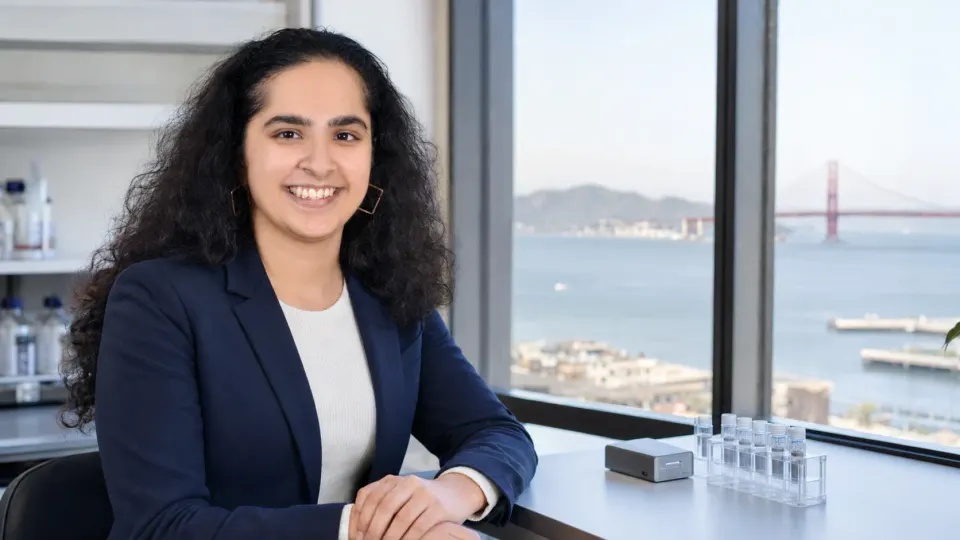
Founded in 2024 by 24-year-old Anagha Rajesh, the company is attempting to solve global data storage constraints by developing hardware that converts digital information into synthetic DNA sequences. The technological thesis relies on the fact that biological systems can store data far more compactly and energy-efficiently than traditional silicon infrastructure, potentially transforming how massive volumes of information are archived.
Over the past two years, BioCompute utilized India's relatively cost-effective scientific resources to establish a laboratory, conduct thousands of experiments, and successfully build an end-to-end prototype. During this period, the startup raised over ₹5 crore from investors, including Nikhil Kamath's WTF Fund, Grad Capital, and 1517 Fund.
However, as the company transitions from the prototype phase to assembling the first commercial version of its DNA data storage chips (V1), Rajesh announced the structural shift to the United States. The relocation necessitates winding down the Bengaluru operations and parting ways with the local team that built the initial technology, a move the founder described as one of the hardest moments of her journey.
In a public blog post, Rajesh explicitly stated that the decision was driven by ecosystem readiness rather than a lack of domestic engineering talent. According to the founder, while India is beginning to support deep-tech initiatives through government frameworks like the ₹1 lakh crore RDI fund, private capital remains largely risk-averse. Rajesh noted that India often prefers to adapt existing Western innovations to the local landscape rather than backing unproven scientific bets. She argued that building new-age data infrastructure capable of challenging legacy giants like IBM requires an ecosystem "built on abundance" that embraces high-risk, high-reward endeavors.
Why It Matters
This relocation matters because it exposes a structural flaw in the Indian venture capital ecosystem: the severe deficit of "patient capital" required for hard scientific innovation. Over the past decade, Indian venture firms have mastered the art of funding software-as-a-service (SaaS), direct-to-consumer (D2C) brands, and quick commerce. These business models allow investors to evaluate execution risk and track revenue generation within predictable quarterly cycles.
Deep tech, specifically hardware-based biological computing, operates on an entirely different timeline. Developing a DNA storage chip involves immense technical risk and requires millions of dollars in research and development before a single commercial product is sold. Rajesh highlighted this disparity, noting that conversations with people in San Francisco focused on what long-term resources were needed to follow the vision through, whereas the Indian ecosystem remains heavily fixated on immediate revenue metrics.
For BioCompute, the timing of the move is an operational necessity. Prototyping in India made economic sense; the initial ₹5 crore capital stretched significantly further in Bengaluru than it would have in the Bay Area. However, commercialising a DNA chip requires a radically different scale of capital and, crucially, enterprise customers willing to beta-test highly experimental frontier technology. Silicon Valley holds a dense concentration of both. By moving now, BioCompute is positioning itself closer to the venture firms that routinely underwrite decade-long scientific bets and the hyperscale cloud providers that will eventually need to adopt DNA storage as traditional data centres exhaust their physical and electrical capacities.
The Strategic Read
BioCompute’s departure signals a concerning dynamic for the Indian innovation economy: the country is at risk of becoming a mere prototyping incubator for global deep tech, rather than the ultimate owner of the resulting intellectual property (IP).
The underlying business mechanism driving this migration is the pricing of technical risk. In mature ecosystems like San Francisco, venture capital functions as true risk capital, underwriting the probability that a scientific breakthrough might fail entirely, but compensating for that risk with the potential of a monopolistic outcome. In India, capital is priced around market execution; investors want to see a proven business model adapted to local socio-economic realities. Consequently, when an Indian founder attempts a genuine "zero-to-one" frontier technology, they hit a hard funding ceiling the moment the prototype is finished and the heavy industrialisation costs begin. This creates an immediate competitive consequence for India's strategic positioning.
Recent market reports indicate that over 100 Indian artificial intelligence and deep-tech founders have either relocated or are planning to move to the US to secure better access to venture capital and early-adopter customers. While the narrative of a "reverse brain drain" holds true for traditional software talent returning to India, the true frontier builders are still fleeing. The leverage point is not engineering talent—which India possesses in abundance—but ecosystem risk appetite. If domestic capital cannot fund these companies through the "valley of death" between prototype and commercialisation, the subsequent high-paying jobs, patents, and geopolitical leverage attached to technologies like DNA storage will continuously default to the United States.
However, the strongest countercase to this migration strategy is the brutal operational reality of Silicon Valley burn rates. Relocating to San Francisco immediately multiplies a hardware startup's fixed costs. Laboratory space, specialised scientific hires, and operational overheads in California will drain BioCompute’s capital reserves at an accelerated pace. If the company fails to secure a massive, US-led Series A round shortly after arriving, the relocation could prove fatal. The geographic move does not guarantee scientific success; it merely changes the currency in which the failure might occur.
For daily, sharp analysis of the biggest moves in the Indian business and startup ecosystem, follow StartupFox.