

 Adani Group
The Story
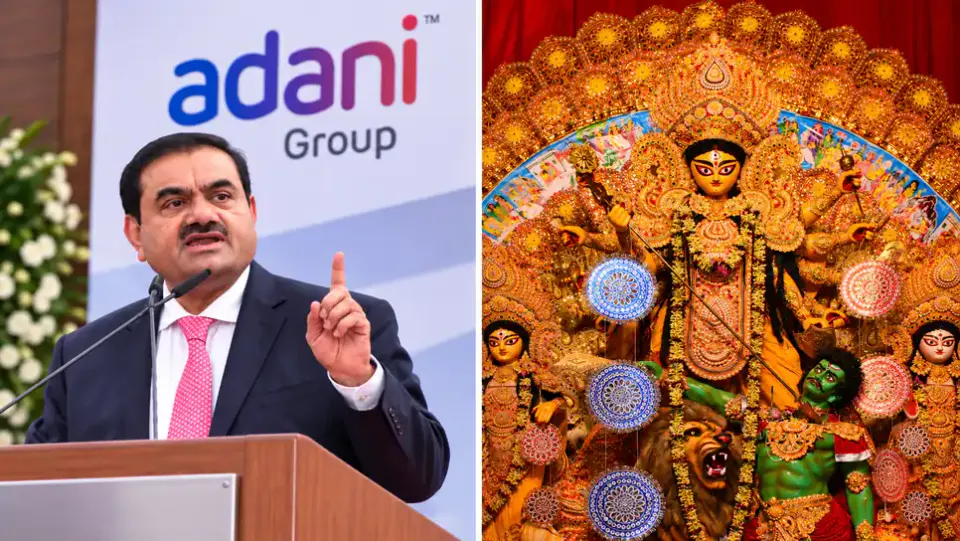
Adani Group is putting ₹2 crore into Kolkata's Durga Puja, directed at the people who make it: theme makers, pandal creators and idol artists.
Under the initiative, nominations can be submitted through durgapujaadani.in until 25 September. Eight Puja committees will be selected for grants of ₹25 lakh each. The group is also planning a Kolkata Durga Puja Preview Tour from 10 to 12 October.
The tour is a curated route through selected pandals, arranged for visitors from India and abroad before the festival opens to the crowds. Sanjay Thare, an adviser to the Adani Group, is coordinating it with the state Information and Cultural Affairs Department. An expert committee will decide which pujas are included, weighing how far preparations have progressed by Mahalaya, location, management, artistic concept, public safety and ease of movement for visitors. Earlier editions covered 24 pujas across north and south Kolkata and ran through the night, and entry this year will run through a QR code-based system with guests applying online.
Durga Puja in Kolkata was inscribed on UNESCO's list of intangible cultural heritage in 2021, which described it as a thriving ground for collaborative work by artists and designers, built around large-scale installations, clay sculpture, craftsmanship and community participation. A British Council study valued the festival's creative economy at more than ₹32,000 crore, close to 3 percent of West Bengal's gross state domestic product.
Why It Matters
Durga Puja draws enormous crowds. But long before anyone walks into a pandal, artists, sculptors, designers and committees have spent months turning an idea into something an entire city will move through.
That layer is where this money is going, and it is an unusual place for corporate money to land.
Corporate participation in large festivals is normally easy to spot. Sponsorship boards, branded gates, advertisements, a logo positioned near very large footfall. It is visibility bought beside something people already care about. Directing the money one step inward, to the people producing the cultural experience rather than to the space around it, is a different proposition.
Durga Puja is unusually suited to that, because of how much of it is made rather than staged. UNESCO, inscribing Kolkata's Durga Puja in 2021, described it as a thriving ground for collaborative work between artists and designers, built on large-scale installations, clay sculpture and craftsmanship. A themed pandal is temporary architecture. It takes months of design, fabrication and labour from idol makers in Kumartuli, bamboo and cloth workers, lighting designers, electricians and structural crews, and it is dismantled within days of the festival ending.
That impermanence is the whole difficulty. There is no collection to hang the work in, no resale, nothing that survives the season except photographs and reputation. Art that disappears is hard to fund, because nobody owns anything at the end of it, and the people who made it start again from nothing the following year.
Which is what makes the direction interesting, whatever the size of the cheque. The strongest cultural associations are rarely built by placing a logo beside something people love. They are built by becoming useful to the ecosystem that makes it possible. The question shifts from how many people will see us to what can exist because we took part, and those produce different kinds of spending.
The Strategic Read
₹2 crore will reach a small fraction of Bengal's Puja landscape. There are tens of thousands of committees across the state, and eight of them will receive this money. As a share of the festival, it is negligible. As a signal about where corporate money can usefully go, it is worth more than that.
The questions that will determine whether it amounts to anything are the ones the announcement does not yet answer.
The first is selection. Nominations are open for three days and an expert committee decides. Who sits on that committee, and what they are weighing, will shape the outcome more than the money does. Durga Puja already has established awards, most famously the paint-company prizes that have run for decades, and those awards did not merely recognise good pandals. They changed what pandals look like, because winning brought footfall and footfall brought next year's sponsors. A new grant of this size will exert the same pull. Whether it rewards technical craft, thematic ambition, or the committees already best placed to win things, will be visible in what gets built next year.
The second is what the grant actually enables. ₹25 lakh can fund a pandal a committee could not otherwise have attempted, or it can substitute for money it would have raised anyway and free that up for something else. The first creates work that would not have existed. The second is useful but ordinary. The difference will show in the pandals themselves.
The third is whether it recurs. One season of funding is a campaign. Repeated over several years, it becomes something artists can plan around, which is what the creative layer of this festival actually lacks. Idol makers and pandal artists work project to project with little visibility beyond the current season, and the value of patronage lies almost entirely in its predictability.
There is a broader point in the approach that is worth separating from this particular grant. Most corporate money in Indian festivals buys attention: hoardings, branded gates, stage banners, presence beside something people already care about. It is measured in impressions and it is fundamentally rented. Funding the making of the thing is a different transaction. It does not produce the same immediate visibility, and it produces a different kind of association, one that is harder to buy and harder to lose.
Whether Adani treats this as the start of something or as a single season's visibility is the question that decides which of those two it turns out to be.
For daily, sharp analysis of the biggest moves in the Indian business and startup ecosystem, follow StartupFox.