

 Orange Health
The Story
Orange Health Labs, the Y Combinator-backed diagnostics platform, posted revenue from operations of ₹138.6 crore in the financial year ended March 2026, up 65% from ₹84 crore in FY25. Its net loss for the year widened to ₹146 crore, according to financial statements filed with the Registrar of Companies.
The figures are drawn from the company's RoC filings. Non-operating income of ₹4.7 crore, largely from net gains on the sale of investments, took total income to ₹143 crore. Diagnostics services were the sole source of operating revenue during the year.
The loss requires unpacking. Loss before tax rose 11% to ₹97 crore. A deferred tax expense of ₹49 crore then took the reported net loss to ₹146 crore. The EBITDA loss stood at ₹92.4 crore, an EBITDA margin of -66.68%. On a unit basis, Orange Health spent ₹1.73 to earn each rupee of operating revenue.
Total expenses rose 36% to ₹240.3 crore from ₹175.9 crore. Employee benefits were the largest cost at ₹72.2 crore, up 43% and about 30% of total spending. Materials for testing rose 40% to ₹42.9 crore. Claims and contract costs were ₹35.8 crore, while marketing held roughly flat at ₹34.4 crore. Rent, R&D, IT, legal and other overheads added a further ₹55 crore.
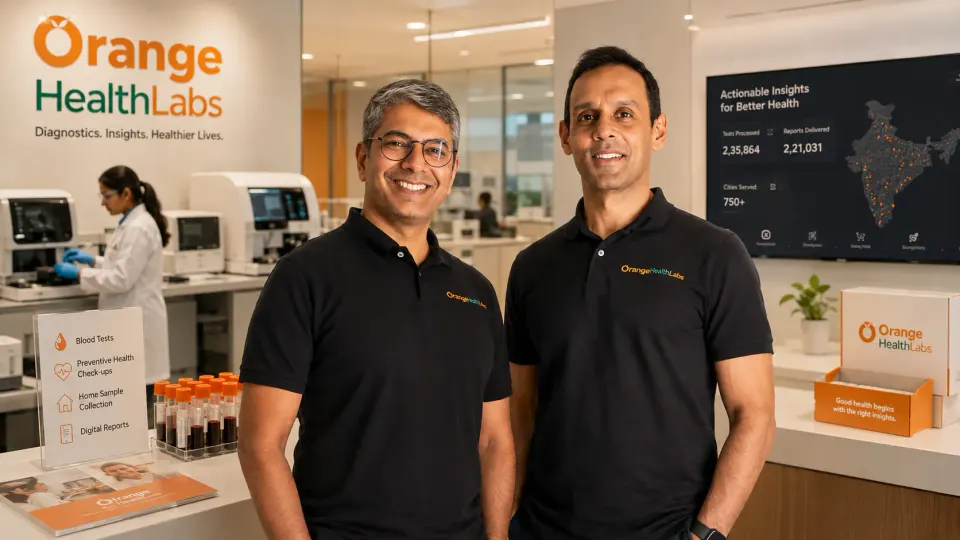
Founded in 2020 by Dhruv Gupta and Tarun Bhambra, Orange Health runs a full-stack diagnostics platform offering on-demand testing and at-home sample collection, and has onboarded more than 2,000 clinics alongside its direct-to-consumer business. It said it added over 60 company-owned collection centres in the past year, nearly 50 of them in Bengaluru.
The company is separately raising a $30 million Series C round led by Iron Pillar, the impact of which it expects to show in its FY27 results. Prior to this round, Orange Health had raised close to $50 million, including a $12 million round led by Amazon Sambhav Venture Fund in 2024 and a $25 million Series B led by General Catalyst and Bertelsmann India Investments in 2022.
As at March 2026, the company had total current assets of ₹55 crore, including ₹4.5 crore of cash and bank balance.
Why It Matters
Orange Health sells speed in a category that historically did not offer it. Its proposition is a sample collected at home within roughly half an hour of booking and a report delivered within six hours, in a market where waiting a day or more for both has been normal. That operational promise, rather than a wider test menu or lower prices, is what the company is built around and what its 65% revenue growth reflects.
The revenue mechanism is straightforward diagnostics: a customer books a test, a phlebotomist collects the sample, an accredited lab processes it and a digital report follows. On top of the direct-to-consumer business, Orange Health has onboarded more than 2,000 clinics that route testing through its platform. The differentiator is entirely in execution speed, which requires dense collection networks and tightly run labs in every city it serves, and the company added more than 60 company-owned collection centres over the year to build that density, most of them in Bengaluru.
That model defines the cost structure, and the FY26 accounts show it plainly. Employee benefits at ₹72.2 crore are the single largest expense, because a fast-collection network is labour-intensive: it runs on phlebotomists, lab staff and logistics people. Testing materials add ₹42.9 crore, and claims and contract costs ₹35.8 crore. These are the costs of physically moving samples and running labs at speed, and they scale with volume rather than falling away as the platform grows.
However, the reported 65% revenue growth does not by itself show the model works financially. Growth of that rate on a business still spending ₹1.73 for every rupee earned demonstrates demand for the service, not that the service can be delivered profitably at scale, and the widening loss shows the two have not yet met.
The Strategic Read
The market assumption being tested here is whether speed can be a durable moat in diagnostics, a business where incumbents compete on scale, menu breadth and network density. Orange Health has built the fastest service in the category, 30-minute collection and six-hour reports, and grown 65% while doing it. The FY26 accounts show what that speed costs to sustain.
The unit-level number is the one to sit with. Spending ₹1.73 to earn a rupee of operating revenue means every rupee of growth is still bought at a loss, and the company grew revenue by ₹55 crore while expenses grew by ₹64 crore. That is the signature of a business buying its way into new markets, and it is defensible as long as the markets it has already bought turn profitable. This is where the company's own framing and its filed accounts pull in different directions: Orange Health says it hit 20% EBITDA profitability in Bengaluru and is operationally profitable across all cities, while the group EBITDA loss for the year was ₹92.4 crore. Both can be true. A profitable home market subsidised by heavy investment in newer cities is a coherent story, but it is a claim about trajectory, not a description of the current group result.
The competitive backdrop is unforgiving on scale. PharmEasy-owned Thyrocare reported ₹829 crore in revenue and ₹163 crore in profit in FY26, a business six times larger and comfortably profitable. Redcliffe Labs was at ₹419 crore in FY25 and Healthians at ₹263 crore, the latter nearly at breakeven. Orange Health is smaller than all three and losing more money than any of them, which is the position of a company betting that its service model, not its size, is what compounds. The incumbents offer 4,000-plus tests against Orange Health's roughly 800, and match on price within a narrow band.
The next round reframes the risk rather than removing it. A $30 million Series C led by Iron Pillar buys time to prove that the Bengaluru economics replicate, and the FY27 accounts will be the first to show whether the newer cities bend towards the home market's profitability or keep the group loss wide. The largest execution risk is structural: diagnostics rewards density and menu depth built over years, and a fast-growing challenger has to reach that scale before its cash burn outruns investor patience, especially with Amazon now operating an at-home diagnostics service built on Orange Health's own rails.
For daily, sharp analysis of the biggest moves in the Indian business and startup ecosystem, follow StartupFox.