


The Story
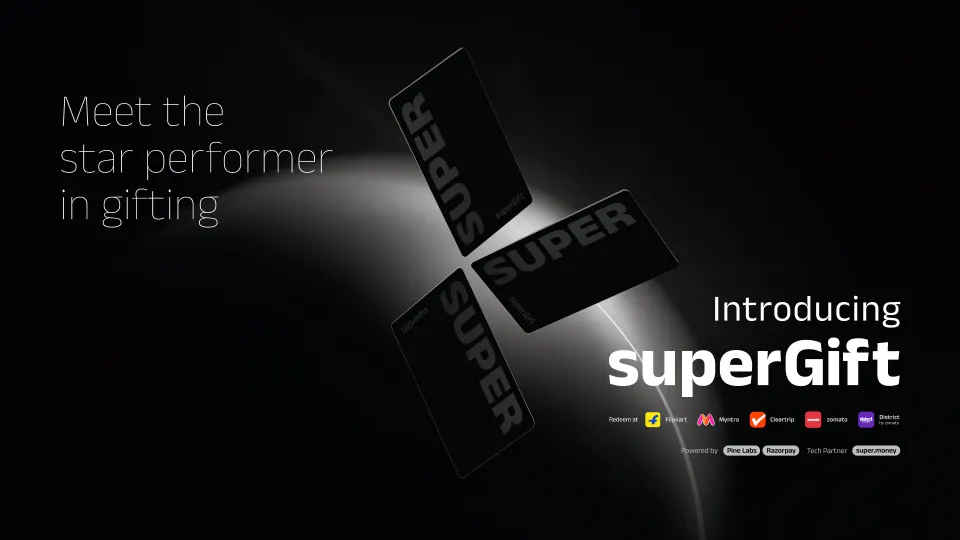
super.money, the Flipkart Group-backed payments app, has launched superGift, a multi-brand gifting product that brings several consumer brands together into a single rewards instrument. The launch was announced on 30 July 2026.
At launch, superGift can be redeemed across Flipkart, Myntra, Cleartrip, District and Zomato, and the company says more partners are expected to join in the months ahead. The brands span everyday consumption as well as travel and occasion-led spending. Redemption is powered by Razorpay and Pine Labs, which handle acceptance, checkout and real-time balance management.
The product is available in both digital and physical formats and is built for individual as well as bulk purchase. super.money is positioning it for enterprise use cases including employee rewards, channel incentives, customer engagement programmes and partner recognition. Details and purchase options are on the superGift site at supergc.super.money.
The company describes superGift as a first for the Indian gifting market, on the basis that a single instrument now spans daily essentials through to premium lifestyle categories with digital redemption and no restrictive conditions attached.
On the market it is entering, super.money cites a 15 per cent year-on-year growth figure for gift cards in CY25, which it attributes to Reserve Bank of India reporting. It argues that fragmentation and limited brand relevance remain the main constraints on the category, and that superGift is built to address both.
Prakash Sikaria, founder and chief executive of super.money, said there was an opportunity to bring back the magic of gifting with a product that has something for every kind of user, and that the company had built a brand ecosystem with frictionless digital redemption to make rewards genuinely beneficial.
super.money runs a UPI and credit-led platform aimed at younger users, combining payments with cashback, secured RuPay cards, credit at checkout and personal loans. The company says it is ISO 27001 and PCI DSS certified.
Why It Matters
A gift card is a promise about where money can be spent, and in India that promise has usually been narrow. Most cards work at one brand, which puts the buyer in the position of guessing what the recipient likes before handing over something that only works if the guess was right. For a company buying thousands of them at once, the guess is worse, because a single choice has to suit an entire workforce.
superGift is built to remove the guess. One instrument carries balance that can be spent across the partner network, so the decision about what to buy moves from the purchaser to the recipient. super.money says redemption is digital and comes without restrictive conditions, and that balances update in real time across the network, which is the part that makes a multi-brand card work in practice rather than just on the marketing page.
The brand mix reflects two different kinds of spending. Flipkart and Zomato cover high-frequency everyday purchases. Myntra, Cleartrip and District cover fashion, travel and going out, which is where gifting tends to be aimed. Covering both means one card can serve a festival gift and a monthly reward without the recipient noticing a gap.
The plumbing sits with Razorpay and Pine Labs, whose payment infrastructure handles acceptance and checkout across the partner brands. That matters more than it sounds. A multi-brand instrument fails at the till, not in the concept, and reconciling balances across several merchants in real time is the operational problem the format has to solve before anything else.
The Strategic Read
The assumption behind superGift is that the constraint in Indian gifting is not supply but relevance. There is no shortage of gift cards. What there has been a shortage of is one card that a recipient can spend on a flight, a kurta and dinner without holding three separate balances.
Corporate gifting is where that matters most commercially. An HR team buying rewards for a few thousand employees has historically chosen between cash, which is taxable and unmemorable, merchandise, which arrives whether it is wanted or not, and a single-brand voucher, which suits whoever happens to like that brand. Choice-based digital instruments solve the third problem only if the choice is wide enough to cover different tastes, which is why the partner list is the product rather than the packaging.
The composition of that list is worth noticing. Flipkart, Myntra and Cleartrip sit within the Flipkart Group, and Zomato and District are both operated by Eternal. Five launch partners, two corporate groups. That makes commercial sense for a first release, since group relationships are quicker to sign than open-market ones, and it also sets the test for the months ahead. A multi-brand instrument becomes genuinely multi-brand when it carries names that have no shareholding relationship with the issuer.
The infrastructure choice points the same way. Razorpay and Pine Labs both operate across large merchant networks rather than inside any one group, which is the sort of plumbing built when the intention is to keep adding acceptance points.
For super.money itself, this is a move sideways rather than deeper. Its existing business earns from consumer payments and credit. A gifting instrument sold in bulk to companies is a different customer, a different sales motion and a different revenue line. Pricing, denominations, validity periods and any fees have not been published, and those terms will decide how the product compares with the enterprise gifting platforms already serving that buyer.
For daily, sharp analysis of the biggest moves in the Indian business and startup ecosystem, follow StartupFox.