
 SUIND
SUINDThe Story
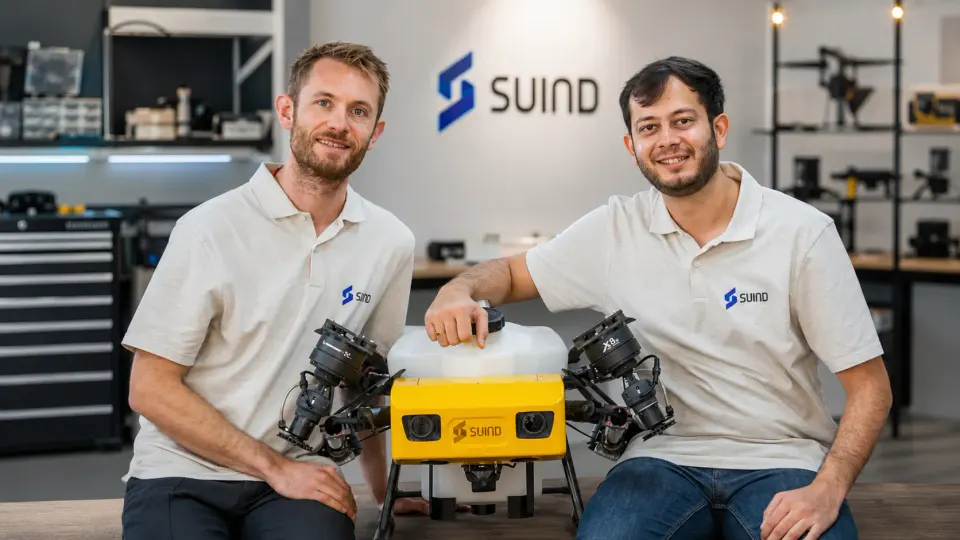
Agriculture drone startup SUIND has raised ₹20.5 crore, or about $2.2 million, in a seed funding round led by Transition Venture Capital Fund. IIMA Ventures also participated. The round was announced on 30 July 2026.
SUIND and its investors have not disclosed the share class issued, the price per share, whether the lead investor takes a board seat, the liquidation preference, or whether the money arrives in one tranche or against milestones. No post-money valuation has been stated by the company. Reporting drawn from the board resolution ahead of the close placed the round at roughly ₹80 crore post-money, which is an outside estimate and not a disclosed figure. The dollar equivalent has been published at $2.1 million in one account and $2.2 million in another.
That same filing-stage reporting put Transition's contribution at ₹20 crore and CIIE Initiatives' at ₹50 lakh, with Transition emerging as the largest external shareholder at 25 per cent. Co-founders Kunal Shrivastava and Kevin Kleber were each shown holding 25.08 per cent after the allotment, Sunicon Ventures 9.22 per cent and CIIE Initiatives 0.62 per cent. IIMA Ventures is the brand under which CIIE Initiatives invests, so the two names in the announcement and the filing refer to the same investor.
This is equity, not debt, and the founders now hold a little over half the company between them.
SUIND says the capital will scale commercial deployment of its agriculture drone platform, accelerate development of its autonomous surveillance and inspection drone, strengthen its autonomy software and expand the engineering team. The company last raised ₹5 crore in November 2023, in a round led by Sunicon Ventures with Zetta Farms and angel investors.
Why It Matters
Crop protection in India is still done by people walking rows with knapsack sprayers. Labour is scarce at the exact weeks it is needed, coverage is uneven on tall crops and plantation terrain, and the operator absorbs the chemical exposure. SUIND, founded in 2020 by Kunal Shrivastava and Kevin Kleber, sells against that problem with Bumblebee, a DGCA-certified autonomous spraying drone the company says it has commercially deployed across farms and plantations.
The technical bet is narrower than the product. Most agriculture drones lean on GPS and a trained pilot. SUIND builds vision-first navigation, which is meant to hold below ten metres and near obstacles where satellite positioning degrades. If that works reliably, the pilot becomes a marker-placer rather than an operator, and the labour cost per acre drops.
Money reaches the company two ways. It can sell airframes, or it can sell spraying as a service, which it currently runs in Baramati. The cost structure sits in the airframe bill of materials, batteries, field teams, certification and the engineering payroll behind the autonomy stack. Service revenue is per acre and recurring; hardware revenue is lumpy and front-loaded.
Neither has shown up yet. According to its latest available filings, SUIND was pre-revenue in FY25 and carried a loss of ₹1.89 crore. FY26 statements have not been filed. Commercial deployment, in the company's own phrasing, has not yet translated into reported sales.
The Strategic Read
The market assumption changing behind this investment is that the defensible layer in drones is the navigation software, not the aircraft, and that agriculture is a cheap place to earn the flight hours that prove it.
The earlier generation of Indian agri-drone companies competed on hardware and distribution. Garuda Aerospace, IoTechWorld Avigation, Marut Drones, BharatRohan and Dhaksha Unmanned Systems built volume around subsidy schemes, dealer networks and pilot training, in a market where central and state support underwrites a large share of each unit sold. That is a real business, but it is a manufacturing and channel business, and it competes with a Chinese supply chain that resets the price of an airframe every product cycle.
SUIND is underwriting something different. Its second product, WASP, is aimed at industrial monitoring, security, surveillance and defence, where contracts are larger and the buyer pays for reliability rather than for a subsidy-adjusted sticker price. Agriculture funds the autonomy work and generates the edge cases; the inspection and ISR market is where the margin is meant to sit.
Whether the moat holds depends on evidence the company has not yet put on the record. Repeat paid acreage, cost per acre against manual spraying, fleet uptime across a season, and independent validation that the vision stack performs in GPS-denied conditions would each be worth more than another certification. So would a named WASP customer.
The execution risk is the size of the cheque against the size of the plan. ₹20.5 crore has to carry two product lines at once, one of them into a defence-adjacent procurement cycle that is measured in years, while the agriculture business is still pre-revenue and the company is spending on manufacturing and hiring at the same time. At an estimated ₹80 crore post-money, the next round will price off evidence rather than narrative, and the runway to produce it is short.
For daily, sharp analysis of the biggest moves in the Indian business and startup ecosystem, follow StartupFox.