

The Story
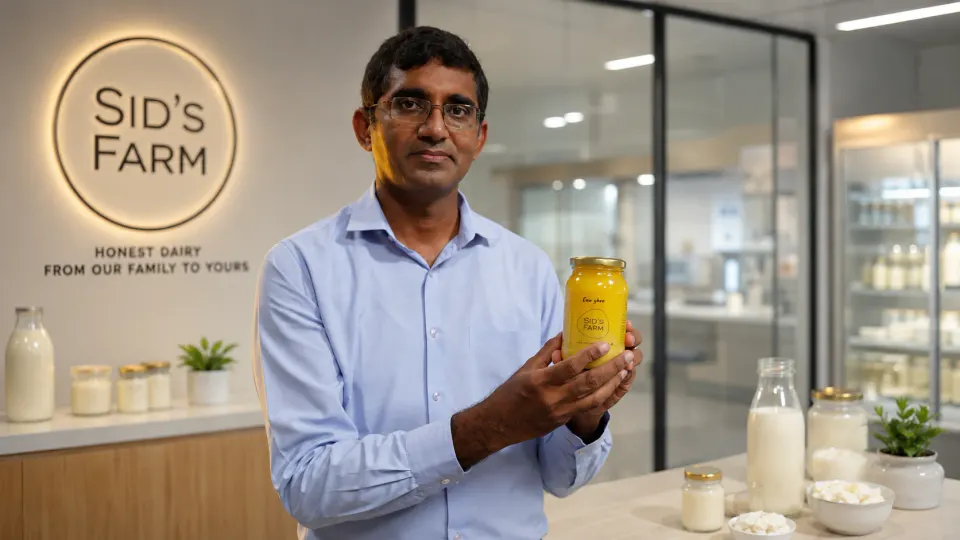
Hyderabad-based direct-to-consumer dairy brand Sid's Farm has raised over ₹81 crore, or about $8.4 million, in a pre-Series B funding round. Existing backers Omnivore and Narotam Sekhsaria Family Office were joined by new investors Dodla Dairy, Next Bharat Ventures and Leaders for India Organisation, along with a consortium of others. The company's own announcement describes all five as leading the round. It was announced on 30 July 2026.
Sid's Farm has not disclosed the valuation, the share class issued, the price per share, how the ₹81 crore splits between the named investors, whether any of it is secondary rather than primary, whether the money arrives in tranches, or what founder Kishore Indukuri holds after the allotment. Board changes have not been stated either.
One number did become public before the announcement. Dodla Dairy, which is listed and competes with Sid's Farm in the same southern markets, told the exchanges that its board approved the acquisition of 2 per cent of Sid's Farm's issued and paid-up equity on 25 July 2026 for a cash consideration of ₹11.64 crore. Read at face value, that prices the whole company at roughly ₹582 crore. Dodla's cheque is close to a seventh of the round.
Sid's Farm says the money will strengthen its supply chain, expand manufacturing and distribution, fund product innovation, deepen farmer partnerships and take it into new markets.
The company raised $10 million in a Series A co-led by Omnivore and NSFO in June 2024, after a $1 million bridge from its own customers and their referrals in January 2023. Reporting in January put total funding at about $12.2 million before this round; one data platform lists $19.4 million across five rounds, a gap that has not been publicly reconciled.
Why It Matters
Loose milk in India is sold on trust and very little else. Adulteration with water, detergent or neutralisers is common enough that the fear of it is itself a market, and the buyer has no way to check what is in the can. Sid's Farm, founded in 2016 by Dr Kishore Indukuri after a stint at Intel in the United States, sells against that fear rather than against another brand.
The mechanism is procurement plus proof. The company says it works with more than 5,000 dairy farmers, provides veterinary support and farmer education, and tests each batch across more than 45 quality and safety parameters, running over 10,000 tests a day. Milk that fails is rejected, and the rejection figures are published. Everything then moves through its own chilling, pasteurisation and delivery network to arrive before seven in the morning. Revenue comes from daily subscriptions across Hyderabad, Bengaluru, Pune and Vijayawada, serving what the company says are more than 50,000 families.
It is an expensive way to sell milk. The FY25 statements filed with the Registrar of Companies show cost of materials at ₹126 crore, employee benefits at ₹25 crore, logistics above ₹13 crore and advertising close to doubling to ₹7 crore.
Growth has not closed that gap. Operating revenue rose 38 per cent to ₹168 crore in FY25 from ₹122 crore, but total expenses rose 47 per cent to ₹196 crore, and the net loss widened 2.6 times to ₹27 crore from ₹10.5 crore. For every rupee earned, the company spent about ₹1.17.
The Strategic Read
The market assumption changing behind this investment is that a premium dairy brand can grow its way out of a gross margin problem, and that the people best placed to judge whether it can are the incumbents it competes against.
Organised dairy in India was built on procurement scale and route density. Cooperatives and listed processors bought milk cheaply across large catchments, spread fixed plant costs over volume, and made money on the spread rather than on the brand. Sid's Farm inverted that. It pays for testing, farmer support and rejection of milk that fails, and it asks the consumer to pay more per litre for the knowledge that this happened. The FY25 accounts show what that costs: raw material at 64 per cent of expenses, cold-chain logistics above ₹13 crore, and a headcount bill rising as fast as revenue.
The bet is that scale eventually fixes it. Fresh milk is a logistics business running against a twelve-hour clock, and margin arrives when a delivery route is dense enough that one van serves enough homes to cover itself. That is a city-by-city problem, and adding Pune and Vijayawada spreads the fleet thinner before density has been reached in the cities already served.
Dodla's 2 per cent is the most interesting line in the deal. For a company running 16 processing plants and around 206 chilling centres, ₹11.64 crore is negligible, and it buys a live view of whether the premium subscription model works. Sid's Farm gets a shareholder with procurement infrastructure across five states. It also gets a competitor on its cap table, with whatever that means for information flow at future board discussions.
At an implied ₹582 crore, the round prices the company at roughly three and a half times FY25 revenue, which is not aggressive for a consumer brand growing 38 per cent. The pressure is elsewhere. Against a ₹27 crore FY25 loss and ₹1 crore of cash and bank balances at March 2025, ₹81 crore is not a long runway if the loss widened again in FY26, and the next round will be priced on margin rather than on growth.
For daily, sharp analysis of the biggest moves in the Indian business and startup ecosystem, follow StartupFox.