
 Rapido
The Story
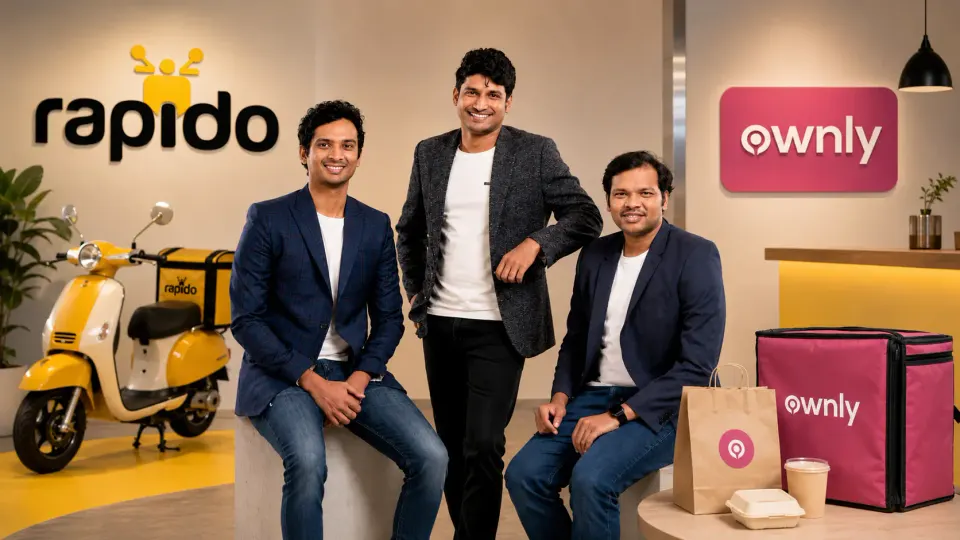
Rapido has integrated Ownly, its food delivery service, into the main Rapido app. Bengaluru users can now order food from the same application they use to book bike taxis, autos and cabs. The change was reported on 28 July 2026. Rapido is running a launch promotion of 50% off, capped at ₹100, on first orders placed through the integrated flow.
Order volumes, the number of restaurants live at the point of integration, the cost of the promotion and any timeline for extending the food tab to other cities have not been disclosed. Nor has Rapido said what share of its user base in Bengaluru has been given access.
Ownly is operated by Ctrlx Technologies, a wholly owned Rapido subsidiary whose directors are co-founder Aravind Sanka and vice president of finance Vivek Krishna, according to filings reviewed by TechCrunch during the pilot. The service began testing in August 2025 across Koramangala, HSR Layout and BTM Layout, and launched across the whole of Bengaluru on 3 March 2026 with roughly 20,000 restaurant partners. Rapido has an arrangement with the National Restaurant Association of India, which claims to represent more than 50,000 eateries, and a tie-up with Magicpin reported to bring a further 80,000 outlets within reach.
The commercial model removes the percentage commission that the established platforms charge restaurants, which runs between 16% and 30% of order value. A flat fee applies instead. Reporting does not agree on who pays it: some accounts describe a fixed subscription charged to restaurants, others a per-order fee, and the company's own launch positioning described a delivery fee borne by the consumer with the restaurant paying nothing.
An earlier expansion plan reported at the time of launch envisaged Ownly operating in ten cities by July 2026.
Why It Matters
Restaurant economics are the pressure point the whole product is built around. A percentage commission scales with the bill, so a platform earns more from a ₹1,200 family order than a ₹200 single meal while doing broadly the same work. Restaurants have been complaining about that arithmetic for years, alongside advertising costs that can exceed ₹30 per order.
A flat fee inverts the relationship. Revenue becomes a function of order count rather than order value, which is precisely how Rapido already runs its mobility business. Its captains pay a subscription rather than surrender a cut of every fare, and that line produced ₹275 crore in FY25 after growing roughly fourteen-fold. Delivery was already Rapido's single largest segment at ₹340 crore of ₹934 crore in operating revenue. Ownly is not a new model for this company. It is the existing model pointed at a different category.
The cost base is where the logic either holds or breaks. In food delivery, the rider is the variable cost, and Rapido owns its rider network outright rather than renting one. A trip that would otherwise be dead time between passenger bookings can in principle carry a meal instead.
However, a flat fee also caps what any single order can earn. On a ₹1,000 basket a commission platform collects several times what Ownly does for identical work. Zero commission is not simply a lower take rate; it is a structurally smaller revenue pool per order, and it means the model needs substantially more orders to reach the same money.
The Strategic Read
The market assumption being underwritten is that distribution now beats aggregation. Swiggy and Zomato spent a decade and enormous sums teaching Indians to open a food app. Rapido's wager is that it no longer needs to, because it already owns a daily-use app and a rider fleet, and can add food as a tab rather than as a business to be built from nothing.
The integration is that wager being placed properly. A standalone Ownly app had five months from citywide launch and remains a single-city product; folding it into Rapido converts every existing Bengaluru rider into a food customer who costs nothing to acquire. The most informative figure available is the one that did not happen. An expansion plan reported at launch put Ownly in ten cities by this month. It is this month, and the news is one city inside a different app.
The shareholder register complicates matters. Swiggy holds roughly 12% of Rapido and has told its own shareholders it would reevaluate that position given the conflict of interest that could arise. A listed competitor part-funding the platform attacking its core business is an unstable arrangement, and it will resolve one way or the other before Rapido reaches the IPO groundwork its co-founder has said begins around the end of 2026.
Zero commission is not a moat. It is a price, and prices are matchable by anyone willing to absorb the same margin. Restaurants list on every platform that sends them orders, so the 20,000 partners are not exclusive and the NRAI relationship buys goodwill rather than supply lock-in. What is genuinely defensible is rider density, which no competitor can replicate without building a mobility business first.
That is also where the risk sits. The flat fee model only works if the marginal cost of a food delivery is genuinely low, which assumes idle rider capacity to absorb it. Food ordering peaks at lunch and dinner. Commuting peaks at roughly the same hours. If the two demand curves overlap rather than complement each other, Rapido is paying full rider cost against a capped fee, and the structural advantage it is counting on does not exist.
For daily, sharp analysis of the biggest moves in the Indian business and startup ecosystem, follow StartupFox.