

 OORJAA
The Story
OORJAA, a Mumbai-based technology-led logistics platform, has raised ₹9.7 crore ($1 million) in a Series A funding round led by Equentis Angel Fund, with participation from Inflection Point Ventures (IPV). The round was announced on 27 August 2026.
The company said this is the first close of a larger round, for which it is in advanced discussions with a few venture capital funds. OORJAA did not disclose a valuation or the equity diluted. It said the fresh funds will go towards technology and product development, scaling Datashastra, its proprietary AI and SaaS logistics stack, and strengthening its control-tower and automation capabilities.
The raise follows two earlier rounds. OORJAA secured $1.5 million in a pre-Series A round led by Micello Fund in September 2023, with Capital-A, Java Capital, Anicut Capital and Lead Angels participating, and ₹5.35 crore in a pre-Series A 2 round from IPV, Vinners Platform, Soonicorn Ventures and HEM Angels in October 2023.
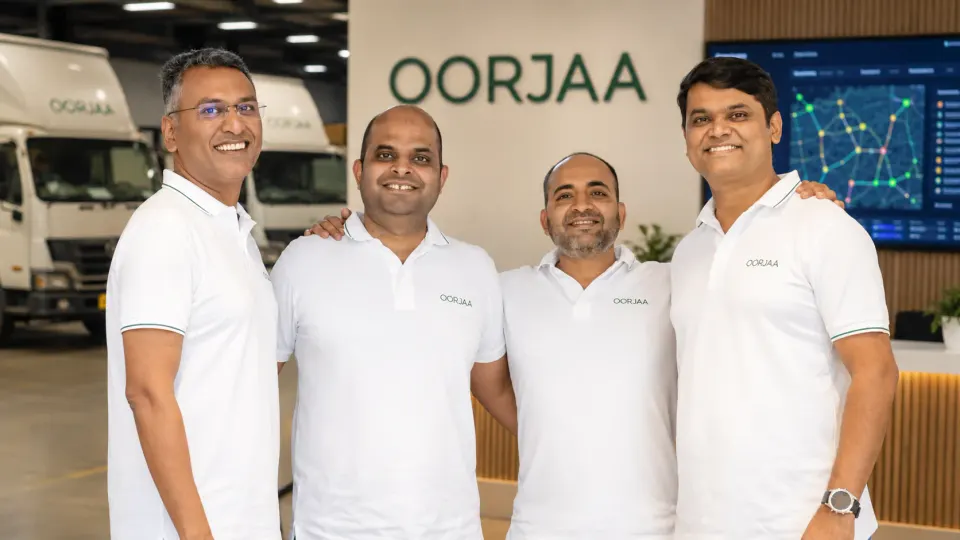
Founded in 2019 by Sandeep Patil, Prashant Mohite, Yogesh Parab and Umesh Singh, OORJAA runs mid-mile and last-mile logistics networks across more than 200 Indian cities. It operates through Yatnavat Technologies Private Limited, whose filings with the Registrar of Companies show revenue of ₹55.2 crore for the year ended March 2024. The size of this first close is therefore small relative to the company's existing revenue base.
OORJAA's differentiator is an outcome-linked cost-per-unit model, under which clients pay for units moved rather than assets deployed. Its Datashastra stack powers route optimisation, reconciliation and round-the-clock control-tower visibility, and is now offered as a standalone SaaS suite internationally, having entered the Gulf market this year. OORJAA said it moves more than 3 million products and 50,000 last-mile orders a day, maintaining 95% service-level compliance for enterprise clients including Zepto, Blinkit, Amazon and Swiggy. Those figures are company-stated. The company is also deploying electric vehicles across dense urban clusters to lower unit costs and emissions.
Why It Matters
OORJAA is built to attack the inefficiency of Indian logistics, a sector long defined by fragmented operators, asset-heavy balance sheets and poor visibility into what actually happens to a shipment. Its proposition is to run mid-mile and last-mile delivery as a technology-led network and to charge for outcomes, units moved, rather than for the trucks and warehouses deployed to move them. For enterprise clients, that promises predictable, usage-linked costs in place of fixed overhead.
The mechanism has two layers. The first is the physical network across more than 200 cities that actually moves goods. The second, and the one OORJAA leans on hardest, is Datashastra, the software stack that plans routes, reconciles transactions and gives clients round-the-clock control-tower visibility. Having built that software to run its own operations efficiently, OORJAA now sells it as a standalone SaaS product, including in international markets, which is how a logistics operator tries to earn software-like margins on top of thin delivery economics.
The cost structure is the tension the business is trying to resolve. Physical logistics is capital- and labour-heavy: vehicles, drivers, fuel and warehousing scale with volume, and margins are slim. The cost-per-unit model only works if the network is efficient enough to earn a spread on every unit, which is why OORJAA emphasises its software and its push to deploy EVs in dense clusters, both aimed at driving unit costs down. The SaaS layer is the attempt to add a high-margin revenue line that does not carry the same physical cost.
However, the company's filed revenue tells a more grounded story than the funding announcement. Yatnavat Technologies reported ₹55.2 crore in FY24 revenue, which shows real scale but also makes a ₹9.7 crore first close a modest raise for a business of this size, and OORJAA has not separated how much of that revenue comes from the high-margin software it is now building the story around. Whether the SaaS pivot delivers the margins the model promises is still to be proven.
The Strategic Read
The market assumption changing behind this round is that logistics can be sold like software, priced on outcomes rather than assets. OORJAA's cost-per-unit model, clients pay for units moved, not trucks deployed, is a genuine departure from the asset-heavy norm of Indian logistics, and its move to sell Datashastra, the software that runs its own network, as a standalone product is the more interesting half of the story. A logistics operator that turns its internal tooling into a SaaS business is trying to bolt a high-margin, capital-light revenue line onto a low-margin, operationally heavy one.
The size of the raise is the fact that reframes everything. A ₹9.7 crore first close is small, and against filed FY24 revenue of ₹55.2 crore it is tiny, less than a fifth of a year's turnover. This is not early-stage capital; it is a top-up from an angel platform ahead of a larger institutional round the company says is still being negotiated. Read charitably, it is a bridge that lets OORJAA bring in investor networks and momentum while the real round closes. Read cautiously, raising a sub-₹10 crore first close on a ₹55 crore revenue base can signal that the larger round is taking longer to price than hoped, and the valuation conversation is the one the company has not disclosed.
The SaaS pivot is where the durable value would come from, and where the evidence is thinnest. Route optimisation, reconciliation and control-tower software are real products, and taking Datashastra into the Gulf as a standalone suite is a sensible hedge. But logistics software is a crowded global category, and there is a difference between software that runs your own network well and software a third party will pay for and rely on. OORJAA has disclosed its logistics volumes but not its SaaS revenue, so the capital-light stream that justifies the software framing remains asserted rather than demonstrated.
The client concentration is the risk that sits underneath all of it. OORJAA's marquee customers, Zepto, Blinkit, Amazon and Swiggy, are precisely the quick-commerce and e-commerce players with both the scale and the incentive to bring logistics in-house, and a cost-per-unit contract is the easiest kind to walk away from once a customer decides to own its own fleet. That is the structural vulnerability of serving giants who can become competitors, and it is very likely why Datashastra is going abroad and why the EV push exists, to lower unit costs enough that building in-house looks less attractive. The largest execution risk is that OORJAA's biggest customers are also its most likely future rivals, and the window to become indispensable, through software and cost, is the thing the full round will need to fund.
For daily, sharp analysis of the biggest moves in the Indian business and startup ecosystem, follow StartupFox.