

 Hugging Face
The Story
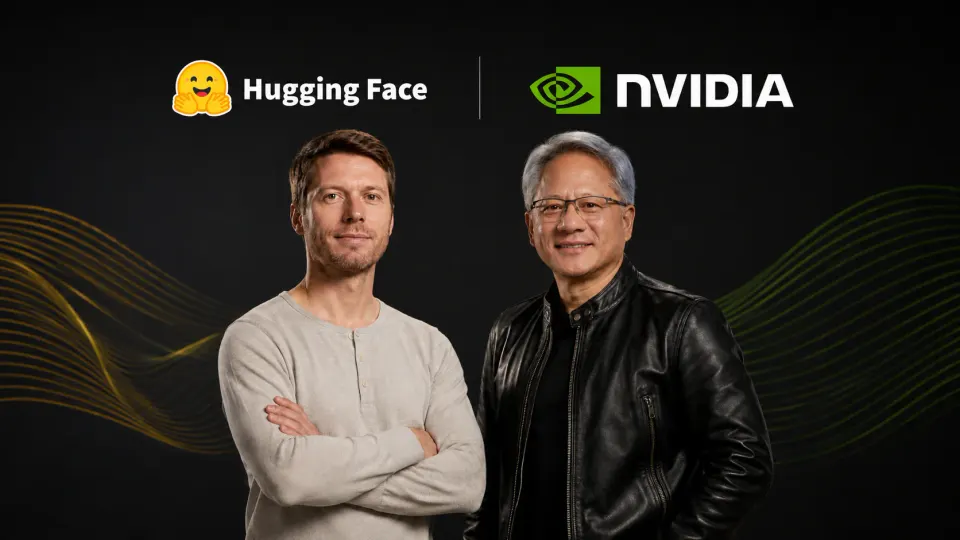
Nvidia has agreed to acquire Hugging Face, the open-source AI platform known as the 'GitHub of AI', for $12.9 billion, according to a report by The Information citing a person with knowledge of the agreement. The report was published on 26 August 2026.
The deal has not been officially confirmed. Neither Nvidia nor Hugging Face responded to requests for comment, according to Reuters, and the terms are so far single-sourced to The Information, with corroboration from CNBC, which cited a person who said an acquisition had been part of recent talks, and Business Insider, which earlier reported Nvidia was in discussions. It should be read as reported rather than closed.
If completed, it would rank among the largest acquisitions in Nvidia's history. New York-based Hugging Face hosts a widely used repository of open-source large language models, datasets and machine learning tools, and has become a default platform for AI developers. The reported price stands far above the company's finances: The Information put Hugging Face's annualised revenue at about $150 million, which would value the deal at roughly 86 times revenue.
The reported price is also a sharp step up from the company's funding history. Hugging Face was valued at $4.5 billion in a $235 million round in 2023 backed by Nvidia, Salesforce and Alphabet's Google. According to a Financial Times report in January, Hugging Face turned down a $500 million investment from Nvidia last year that would have valued it at about $7 billion.
Nvidia's interest comes as builders of closed-source models, including OpenAI and Anthropic, work on their own chips to reduce dependence on Nvidia's graphics processing units. Owning Hugging Face would move Nvidia up the AI stack, from supplying the processors that train and run models to controlling a central hub where developers discover and distribute them. The move follows other expansions of Nvidia's software reach, including a reported $6 billion technology licence from AI coding startup Poolside.
The reported deal also follows a recent security incident at Hugging Face, which its chief executive Clément Delangue attributed to engineering mistakes. It comes in the same week Nvidia forecast a 70% jump in revenue for its next fiscal year and said it had committed $18 billion to equity investments through fiscal 2027.
Why It Matters
Hugging Face occupies an unusual position in AI: it is neither a chipmaker nor a frontier model lab, but the shared infrastructure both depend on. Often called the 'GitHub of AI', it is where developers, researchers and companies discover, share and deploy open-source models, datasets and machine learning tools. That role as a neutral, central meeting point is what makes it strategically valuable far out of proportion to its revenue.
The company's business is built on that community rather than on a single product. Its repository hosts open-source large language models and datasets used across the industry, and its tools have become a default part of how AI applications are built. Revenue comes from paid enterprise services, hosting and compute layered on top of the free platform, which is why its roughly $150 million in annualised revenue is small relative to its influence: the platform's reach is enormous, but most of its usage is free and open.
For Nvidia, the strategic value is not the revenue but the position. Nvidia dominates the hardware that trains and runs AI models, but it has historically sat one layer below the developers who choose which models to build and deploy. Owning Hugging Face would put it at that decision point, where the open-source toolchain meets the hardware, and the deeper that toolchain is tied to Nvidia's platform, the harder it becomes for developers to migrate to rival chips even if big customers build their own.
However, the reported price cannot be justified by Hugging Face's current economics, and that is the crux. A $12.9 billion valuation on about $150 million of revenue only makes sense as a bet on strategic control of open-source AI's distribution, not on the platform's financial performance. Whether that control proves as durable and defensible as the price implies is unproven, and it depends on Hugging Face retaining the developer trust that a change of ownership could just as easily undermine.
The Strategic Read
The market assumption changing behind this deal is that in AI, controlling where developers build has become as strategically valuable as supplying the hardware they build on. Nvidia already owns the compute layer; buying Hugging Face would give it the distribution layer, the place where open-source models are discovered, benchmarked and deployed. The logic is defensive as much as expansionary: as OpenAI, Anthropic and Google design their own chips to escape Nvidia's pricing, owning the developer hub is a way to keep the ecosystem anchored to Nvidia regardless of what silicon sits underneath.
That strategic case is strong, and it is exactly why the price demands scrutiny rather than applause. At a reported $12.9 billion against roughly $150 million in revenue, the deal is priced at about 86 times sales, a multiple that has nothing to do with Hugging Face's current financials and everything to do with its position. Nvidia is not buying revenue; it is buying a chokepoint. Whether that is worth $12.9 billion depends entirely on the belief that open-source AI development remains central and that owning its main venue confers durable advantage, and both are assumptions, not facts. The same company turned down a deal valuing Hugging Face at $7 billion barely a year ago, which means the strategic premium roughly doubled in twelve months, a pace that says more about the AI arms race than about the asset.
There is a structural tension the deal cannot fully resolve, and it is the one to watch. Hugging Face's value rests on neutrality: developers trust it precisely because it is not owned by a model builder or a chipmaker, and it hosts everything regardless of what hardware it runs on. Placing it inside Nvidia risks eroding the neutrality that made it valuable, and competitors who currently rely on the platform, including the very chip-designing rivals Nvidia is trying to box in, may look for alternatives if they fear the hub now favours Nvidia's stack. An acquisition meant to lock in an ecosystem can, if mishandled, fracture it.
The wider frame is an AI market already being questioned for exactly this kind of pricing. Zoho's Sridhar Vembu has called AI valuations an "insane bubble," and an 86-times-revenue acquisition funded by a company that is simultaneously committing $18 billion to equity investments across the sector invites the circular-financing critique that has trailed Nvidia's ecosystem spending. The strongest reading is that Nvidia, forecasting 70% revenue growth, is using an extraordinarily strong position to buy strategic insurance while it can. The most cautious reading is that a deal at 86 times revenue is only rational if the AI boom keeps compounding, and the largest risk is the one no strategic logic covers: that the demand underwriting these multiples is assumed rather than guaranteed.
For daily, sharp analysis of the biggest moves in the Indian business and startup ecosystem, follow StartupFox.