

 Neuromod Aqua
The Story
Neuromod Aqua, a New Delhi-based water infrastructure startup, has raised an undisclosed pre-seed round from Porush Jain, the founder of Sportskeeda. The round was announced on 20 August 2026.
The amount was not disclosed, and Neuromod Aqua did not name any other investors or share a valuation. Porush Jain is the sole named backer of the round.
The company said it will use the capital to build a factory-manufactured platform for decentralised sewage and effluent treatment, standardising the design, manufacturing, installation and servicing of treatment plants rather than delivering each one as a bespoke engineering project.
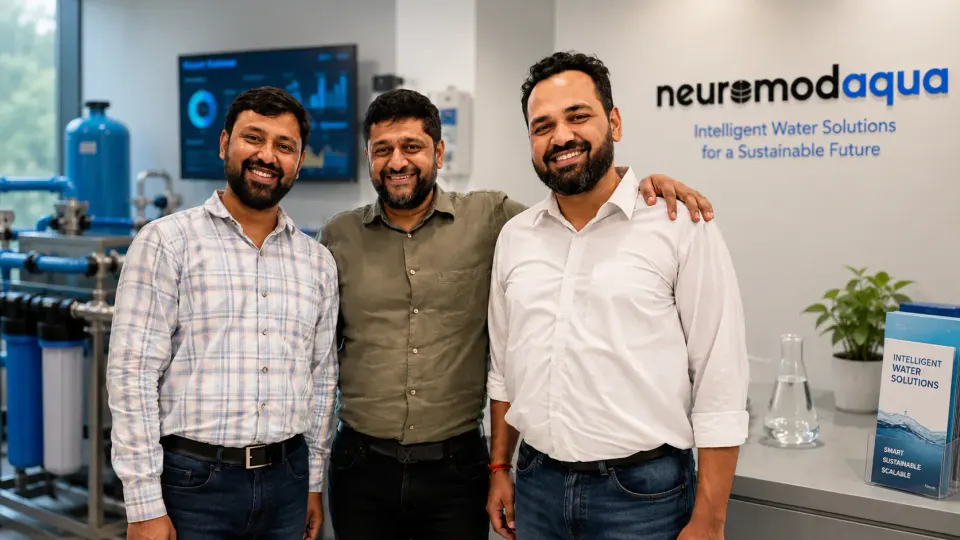
Founded in 2026 by Anuj Arora and Anand Dad, Neuromod Aqua develops modular wastewater treatment plants using established biological technologies, including MBBR, MBR and SBR. Arora is the founder and chief executive; Dad, the co-founder and chief technology officer, is an environmental engineer trained at Georgia Tech. The legal entity, Neuromod Aqua Private Limited, was incorporated in Delhi on 25 May 2026, which makes this an early cheque into a roughly three-month-old company.
Over the next 12 months, the company plans to complete a manufacturing facility, develop and validate its productised sewage treatment plant, complete initial commercial deployments across Delhi NCR, and build a service and spare-parts network. It said it later intends to expand into effluent treatment, zero liquid discharge, water reuse, reverse osmosis and demineralisation applications.
The company has said it aims to derive a growing share of its revenue from annual maintenance contracts, operations and maintenance, compliance support, equipment replacement and remote monitoring, tying its economics to how a plant performs after it is commissioned.
Why It Matters
The problem Neuromod Aqua is chasing is not that India cannot treat sewage, but that it does not. Central Pollution Control Board figures put daily sewage generation at around 72,368 million litres per day against installed treatment capacity of 31,841 MLD, and actual treatment of only about 20,235 MLD. The gap between what is generated and what is genuinely treated is enormous, and a 2025 CEEW analysis estimates the country may need an additional 70,000 MLD of capacity by 2047.
Much of that gap is not a technology gap. MBBR, MBR and SBR are proven biological treatment methods used worldwide. The failure is in delivery: treatment plants are typically designed and built as individual engineering projects, which the company argues produces unpredictable execution, fragmented accountability and poor long-term ownership once the contractor leaves. A plant that is built but not maintained stops treating to standard, and no one is on the hook.
Neuromod Aqua's answer is to treat the plant as a product rather than a project. It wants to standardise design, manufacture units in a factory, install them in a repeatable way and service them over their life. The revenue logic is twofold: an upfront sale of a manufactured plant, then a recurring stream from maintenance, compliance support, spare parts and remote monitoring. The cost structure is that of a manufacturer, tooling, a facility, inventory and field service, not that of a software company.
However, describing this as productising water infrastructure does not by itself make the economics work. A manufactured, serviced plant is still a physical object that must be built, transported, installed and maintained, and the company has not yet demonstrated a completed deployment or the unit cost of one. The thesis is coherent; the evidence is a plan.
The Strategic Read
The market assumption changing behind this investment is that sewage treatment in India is failing on execution, not on science. The underlying technologies are decades old and well understood. What breaks, on this thesis, is everything around them: plants built one-off by contractors, commissioned and abandoned, with no accountability for whether they still work a year later. Neuromod Aqua is betting that turning the plant into a manufactured product with a service contract attached fixes the part that actually fails.
The regulatory backdrop makes the demand non-optional. Central and NGT rules require on-site sewage treatment for large residential, commercial and institutional buildings, and bulk generators discharging above set thresholds must treat to strict standards before release or reuse. That converts treatment from a choice into a compliance obligation for a large and growing set of developers and institutions, which is a more durable demand driver than most early-stage markets have.
The recurring-revenue design is the most interesting part of the model. By pushing its economics towards annual maintenance, operations, compliance support and remote monitoring, Neuromod Aqua is trying to escape the trap of one-off project revenue that has defined the sector. If it works, the company sells a plant once and earns from it for years, and its incentives stay aligned with the plant running properly, which is precisely what one-off contractors have no reason to care about. That is the difference between a manufacturing business and a services annuity, and the pitch is that it can be both.
None of this is proven, and the stage is the point. Neuromod Aqua has not built its factory, validated its product or completed a deployment; the roughly $25 million project pipeline it cites is a company claim, not booked revenue. Water infrastructure is capital-heavy, sales cycles run through developers and government bodies that pay slowly, and a pre-seed cheque of undisclosed and presumably modest size has to fund a manufacturing build before meaningful revenue arrives. The largest execution risk is the gap between an elegant productisation thesis and the industrial reality of manufacturing, installing and servicing physical plants at scale, which is a much harder business than the software framing of "turning projects into products" suggests.
For daily, sharp analysis of the biggest moves in the Indian business and startup ecosystem, follow StartupFox.