
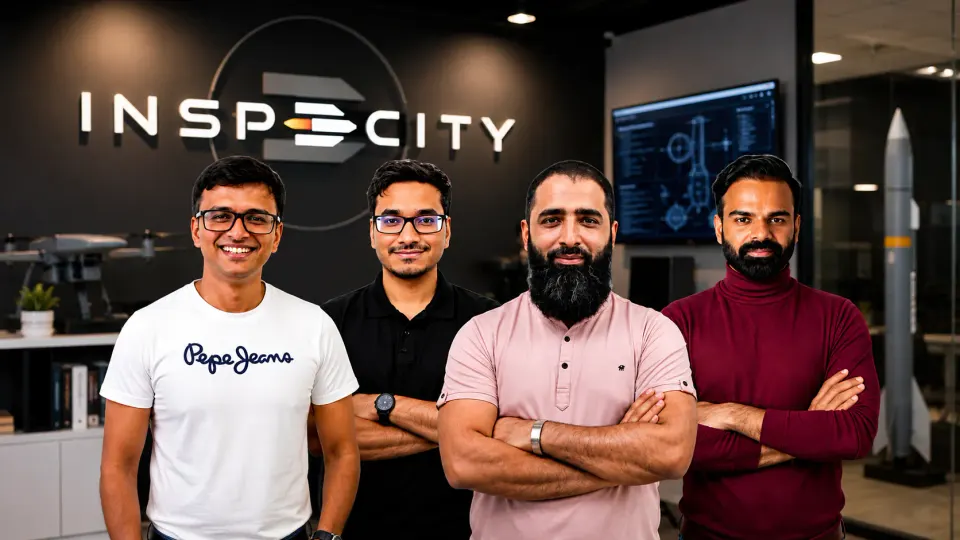

 InspeCity
The Story
InspeCity, an IIT-Bombay-incubated space-tech startup, has raised ₹100 crore ($10.5 million) in a pre-Series A funding round co-led by Speciale Invest and investor Ashish Kacholia. The round was announced on 27 August 2026.
Antler Elevate, Antler India, Manish Gandhi and Shastra VC also participated. InspeCity did not disclose a valuation or the equity diluted in the round.
The round follows a $5.6 million (about ₹46 crore) seed round in May 2026, also led by Ashish Kacholia, and a $1.5 million pre-seed round led by Speciale Invest. The latest raise takes the company's total funding to roughly ₹150 crore. InspeCity said the fresh capital will be deployed towards flight qualification and scaling its commercial activities.
Founded in 2022 by Arindrajit Chowdhury, a professor at IIT Bombay, and Tausif Shaikh, InspeCity develops in-space servicing, assembly and manufacturing (ISAM) technologies aimed at extending satellite lifespans and addressing the growing problem of space debris. It is building an autonomous in-space servicing architecture called VEDA (Vehicle for Life-Extension and Deorbiting Activities), designed to service satellites in orbit and deorbit them safely at end of life.
The company has broken satellite servicing into a set of underlying modules: GITA for propulsion and mobility, CHAKSU for sensing, navigation and proximity operations, RAMA for robotic manipulation, and SPARSH for cooperative docking and in-orbit refuelling. Together these are meant to build up to progressively more capable orbital platforms spanning inspection, life-extension and maintenance.
Over the next 12 to 18 months, InspeCity said it plans to execute four in-orbit missions under a roadmap it calls RIG-X, VEDA-X and SAMA-X, validating its propulsion, sensing, autonomous operations, robotics, docking and refuelling capabilities in space. The company has previously won contracts under India's iDEX defence innovation programme and has formed partnerships with space-tech players in Japan and Taiwan.
Why It Matters
InspeCity is chasing a problem that grows more urgent with every satellite launched: what happens to spacecraft when they run out of fuel or fail, and how to keep low-Earth orbit usable as it fills with hardware. Satellites are expensive assets that are typically abandoned once their propellant is spent, even if everything else still works, and dead spacecraft become debris that threatens everything around them. InspeCity's proposition is to service satellites in orbit, extending their lives and removing them cleanly at the end.
The company is building this as a stack of in-space servicing, assembly and manufacturing technologies rather than a single product. Its VEDA platform is designed to rendezvous with a satellite, dock with it, and then either extend its life through propulsion and refuelling or guide it to a controlled deorbit. Underneath sit the hard capabilities that make that possible: green propulsion, precise sensing and navigation, a robotic arm, and an autonomous docking-and-refuelling port. Each is a building block that InspeCity intends to validate in orbit before assembling them into full servicing missions.
The economics of this are the economics of deep-tech hardware, not software. The costs are heavy and front-loaded: years of R&D, expensive test campaigns, and launches to demonstrate each capability in the environment it must ultimately work in. Revenue, by contrast, arrives late and lumpy, through government R&D contracts, defence programmes such as the iDEX wins InspeCity has already secured, and eventually commercial servicing contracts once the technology is proven. This is why the funding is aimed at flight qualification and missions rather than marketing or scale.
However, none of the commercial promise is proven until the hardware works in orbit. InspeCity has validated capabilities on the ground and won early contracts, but it has not yet demonstrated autonomous servicing in space, which is the entire proposition. The four missions this round funds are precisely the test, and until they fly successfully, the company's value rests on engineering credibility and investor conviction rather than a working orbital service.
The Strategic Read
The market assumption changing behind this round is that in-space servicing, long the preserve of national space agencies and a handful of Western companies, is becoming a commercial market a startup can build a business in. As satellites proliferate and orbital debris becomes a genuine operational hazard, the ability to refuel, reposition, repair and deorbit spacecraft turns from a research curiosity into a service someone will pay for. InspeCity is betting India can produce a competitive player in that market, and its investors are paying up for a technically credible team early.
The strategy of decomposing the problem is the most defensible part of the plan. Rather than promising a single miraculous servicing spacecraft, InspeCity has broken satellite servicing into propulsion, sensing, robotics and docking modules, each a hard engineering problem in its own right, and each individually useful. That modularity means capabilities can be validated, and potentially sold, one at a time, which de-risks a very long development path and gives the company intermediate revenue possibilities before the full VEDA platform flies. Docking and in-orbit refuelling in particular are among the hardest things to do in space, and getting them working would be a genuine moat.
The capital, though large by Indian space-tech standards, is small against what the mission demands, and that is the tension this round sits on. A ₹100 crore pre-Series A is a substantial cheque, and total funding near ₹150 crore is real, but four in-orbit missions in 12 to 18 months is an extraordinarily compressed and expensive schedule for a company that has not yet flown its core technology. Space hardware is unforgiving: launches slip, qualification takes longer than planned, and a single failed demonstration can reset a roadmap and a fundraising narrative at once. The gap between a validated module on the ground and a working autonomous servicer in orbit is where most of the risk, and most of the remaining cost, lives.
The competitive and revenue questions are the ones that will decide whether this becomes a company or stays a programme. Globally, ClearSpace, Starfish Space and Astroscale are chasing the same servicing-and-debris market with more capital and, in some cases, flight heritage; domestically, the better-funded Indian space names are mostly in launch and earth observation rather than servicing, which leaves InspeCity a relatively open niche at home. Its early iDEX defence contracts point to the likeliest near-term customer, the Indian government, which is both a durable buyer and a slow, procurement-bound one. The largest execution risk is simply physics and time: the company has to get hardware working in orbit, on schedule and on budget, before the capital and investor patience that a pre-revenue deep-tech venture runs on are exhausted.
For daily, sharp analysis of the biggest moves in the Indian business and startup ecosystem, follow StartupFox.