

 Hadrian
The Story
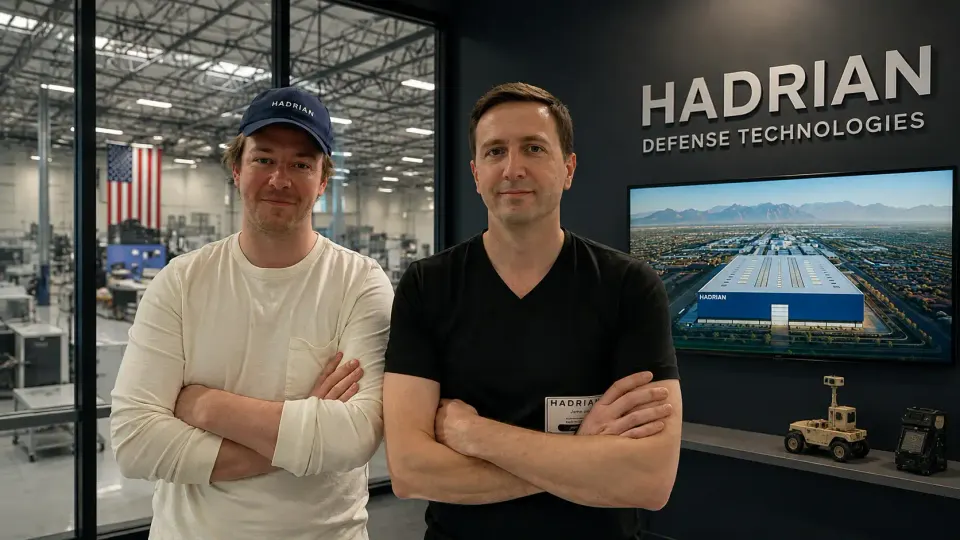
Hadrian, a US defence-technology company that builds automated factories for precision manufacturing, has raised $1.37 billion in a Series D round at a valuation of $7.87 billion. The round was announced on 6 August 2026.
The lead investors are WCM Investment Management, Washington Harbour Partners, Valor Equity Partners, 137 Ventures and Baillie Gifford. Participating investors include 1789 Capital, Morgan Stanley Wealth Management, funds managed by Apollo and T. Rowe Price, and existing backers CapitalG, Andreessen Horowitz, Founders Fund, Lux Capital and Altimeter, among others. Founders Fund and Lux led the company's $260 million Series C about a year earlier.
Hadrian has not disclosed how the proceeds break down between factory construction, working capital and equipment, nor how much of the raise is primary capital versus secondary sales. The valuation is a figure the company has stated rather than one drawn from a public filing; as a private company, Hadrian is not required to disclose the terms, share class or liquidation preferences attached to the round.
The raise more than quadruples the company's valuation in roughly a year, from about $1.6 billion at its Series C to $7.87 billion. It is one of the largest private financings in defence manufacturing to date, and by PitchBook's estimate takes Hadrian's total capital raised past $2 billion. The company builds facilities that mass-produce components for defence platforms the US military already operates, rather than developing new weapons systems of its own.
Why It Matters
Hadrian sells manufacturing capacity rather than a finished weapon. Its factories use software and automation to produce high-precision metal parts, components machined to tolerances measured in microns, for aerospace, space and defence customers, and it also runs a factory-as-a-service model that lets primes such as Lockheed Martin route production through its plants. The company earns by making parts faster and at lower cost than the fragmented network of legacy machine shops it is designed to replace.
The problem it targets is structural. America's defence supply chain depends on thousands of small machine shops whose skilled workforce is retiring, with few trained to take their place, and that shortage has become a bottleneck as defence spending rises. Founder and chief executive Chris Power, an Australian who previously ran a manufacturing-focused private equity fund, built Hadrian on the argument that the only way to close the gap fast enough is to make the factory itself the product, automating scheduling, inspection and machining that were traditionally manual.
That model is capital-hungry by design. Each facility is a large upfront investment: the company opened a submarine-parts plant in Alabama in March, its fourth facility, under a public-private partnership valued at $2.4 billion, and it has expanded into Arizona with further sites planned. Hadrian has funded this through a mix of equity and debt across its rounds, a structure that speeds the build-out while adding fixed financial obligations.
What the funding does not by itself prove is unit economics at scale. Hadrian's reported revenue was around $30 million in 2024, up sharply from an estimated $3 million the year before, but that remains small against the capital deployed. Rapid revenue growth shows the factories can win work; whether each new plant earns its cost of capital as the network expands is the question the model still has to answer.
The Strategic Read
The market assumption changing behind this investment is that the binding constraint on Western defence is no longer design but production, and that the factory itself, rather than any single weapon, is the asset worth owning. Hadrian is a bet on manufacturing capacity as strategic infrastructure, priced accordingly.
The timing explains the size. Governments across the US and Europe have committed to rearmament on a scale not seen in decades, while the industrial base that would supply it has thinned, with skilled machinists ageing out and few replacements trained. A company that can stand up automated capacity quickly is selling into demand that is politically durable rather than cyclical, and the roster of crossover investors, sovereign-adjacent funds and public-market managers reflects a view that this is a multi-year build rather than a venture bet.
Where the thesis is most exposed is the gap between valuation and revenue. At an estimated $30 million in 2024 revenue, a $7.87 billion valuation is roughly 260 times trailing sales, a multiple that only holds if Hadrian executes a capital-intensive factory rollout close to flawlessly. Manufacturing does not scale like software: each facility is fixed cost, long lead time and hard to reverse, and the capital raised buys buildings and machines rather than code that replicates at zero marginal cost. The debt layered alongside the equity across earlier rounds adds fixed obligations to that burden.
The largest execution risk is concentration. Hadrian's demand depends heavily on US defence procurement and a handful of large primes and government partnerships, which makes it exposed to budget cycles, programme delays and political shifts in a way a diversified manufacturer is not. The valuation prices Hadrian as though it has already become critical national infrastructure; whether the factories deliver at volume, and on contracts that recur, is what the next few years will test.
For daily, sharp analysis of the biggest moves in the Indian business and startup ecosystem, follow StartupFox.