
 Scapia
The Story
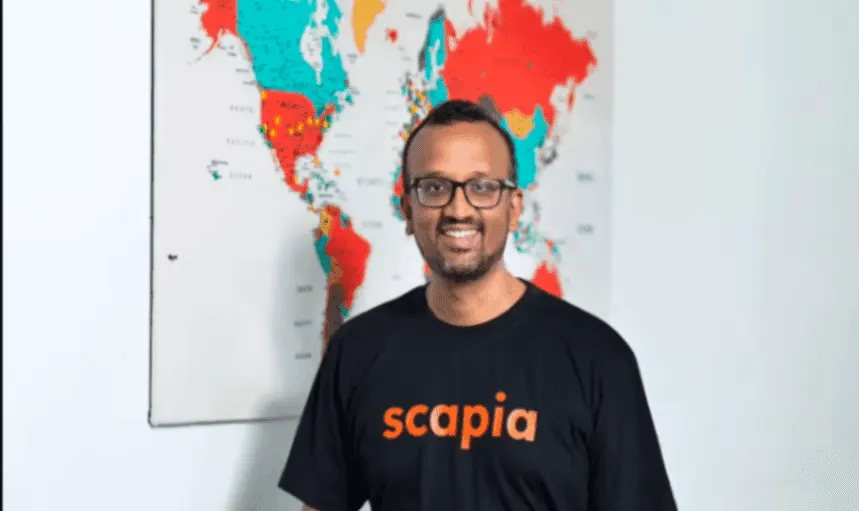
Scapia, the travel-focused fintech platform founded by former Flipkart executive Anil Goteti, has secured a massive $63 million funding round led by global venture firm General Catalyst. Existing backers Peak XV Partners and Z47 also doubled down on their investments in the Bengaluru-based startup. This new capital injection has pushed the company’s valuation past the $500 million threshold, effectively more than doubling its $200 million valuation from just a year prior. Having raised over $125 million in total capital since its inception in 2022, Scapia plans to use the fresh liquidity to aggressively scale its customer base, expand its suite of AI-driven tools for personalized discovery, and introduce new financial offerings like short-term travel loans.
Why It Matters
To understand Scapia's explosive valuation jump amidst a broader global slowdown in fintech dealmaking, one must look at the highly lucrative unit economics of its specific model. Traditional credit cards often struggle with high customer acquisition costs (CAC) and generic reward catalogs that fail to drive deep, repeated engagement. Scapia bypasses this structural bottleneck by operating a closed-loop ecosystem at the exact intersection of aspiration and transaction. By partnering with institutions like Federal Bank and Bank of Baroda, Scapia issues co-branded cards where rewards (Scapia Coins) are natively earned on everyday domestic spends and UPI payments, and then directly burned on high-value travel bookings managed entirely within the same app. This system allows Scapia to capture interchange fees on the card swipes, earn vendor commissions on the flights and hotel bookings, and potentially lock in interest margins on upcoming credit products—all while retaining the customer through a gamified, travel-focused user experience.
The Strategic Read
Zooming out, Scapia's rapid scaling signals a fundamental unbundling of the Indian retail banking interface. Young millennials and Gen Z consumers, a demographic whose purchasing power is projected to cross $100 billion by the end of the decade, are increasingly rejecting one-size-fits-all legacy banking apps in favor of verticalized financial products that align directly with their lifestyle choices. Scapia reported an 8x year-on-year growth in stay bookings, heavily driven by Tier-2 and Tier-3 cities, proving that domestic and international travel is no longer a luxury reserved for the metro elite but a core utility for the aspirational middle class. For incumbent banks and legacy online travel aggregators (OTAs) like MakeMyTrip, this presents a direct and growing threat. Scapia is essentially building an OTA disguised as a fintech app, using the stickiness of a daily payment product to continuously cross-sell high-margin travel inventory. If this model sustains its momentum, it will force massive legacy players to rethink their loyalty frameworks entirely or risk losing their most profitable demographic to agile, niche startups.
For daily, sharp analysis of the biggest moves in the Indian business and startup ecosystem, follow StartupFox.