
The Story
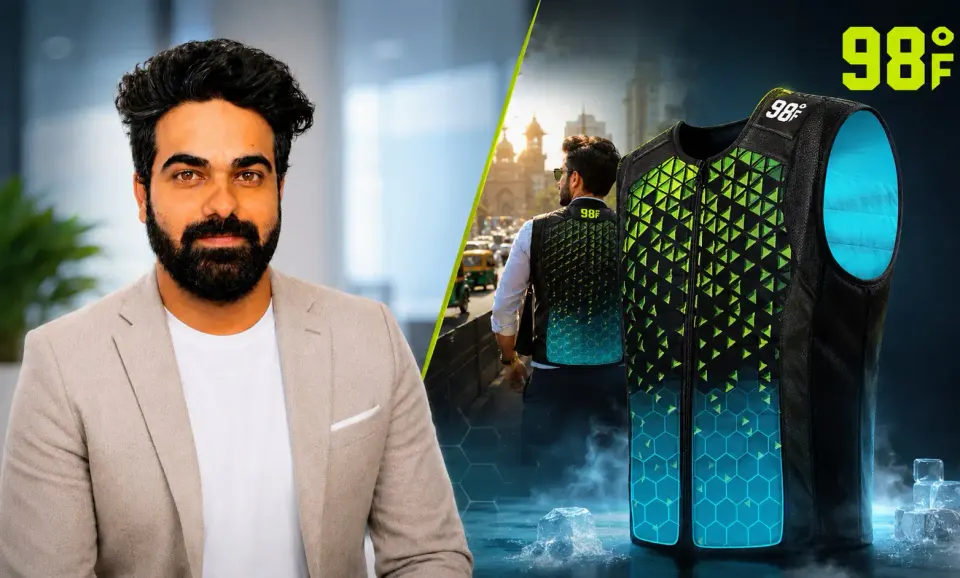
Every summer, millions of Indians step out into temperatures that most people wouldn't survive an hour in — and they do it for eight to ten hours at a stretch. Delivery riders, traffic police, construction workers, warehouse staff. For most of them, there's no relief except shade that rarely comes. Vikkas Singh noticed this before it became a headline. In 2021, the Haryana-born entrepreneur founded 98 Fahren in Gurugram with a bootstrapped investment of ₹76 lakhs and a single obsession: building a wearable cooling product that actually works in India's conditions. Four years later, the company has sold over a million cooling vests, ships to 20+ countries, and counts Amazon, Royal Enfield, Zomato, and multiple state police forces across India among its clients. The cooling vest alone went through more than 10 prototypes over three years before hitting the market.
Why It Matters
Vikkas didn't come from a hardware or textile background. He'd worked in international media, moved into commodity exports in Mumbai, and eventually co-owned a Dutch-based apparel company that worked on functional clothing — a stint in the Netherlands that planted the seed for 98 Fahren. Back in India, the idea started small: perishable cooling baskets for companies like Big Basket and ONLY Fresh. Then helmet liners for motorcycle riders and industrial workers. Then cooling vests. The problem they were solving was not complex to understand but brutally hard to solve — how do you keep a human body cool without electricity, without bulk, without making the solution worse than the problem? 98 Fahren's answer works across three technologies: evaporative cooling, PCM-based (phase change material) cooling, and advanced wearable thermal systems. None require a battery. The vests provide three to eight hours of cooling depending on the environment. The company built its own manufacturing facility in Gurugram capable of producing up to two lakh vests a month at peak, and runs an in-house lab with life-size mannequins for real-condition temperature and humidity testing.
The Strategic Read
India is getting hotter, and the people most exposed to that heat are the ones building, delivering, and running the country. India's outdoor workforce — from gig delivery riders to traffic police to construction labour — numbers in the hundreds of millions, and heat-related illness and fatigue cost productivity, health, and in the worst cases, lives. Yet wearable cooling as a category was essentially non-existent at scale in India before startups like 98 Fahren entered the picture. That the company is bootstrapped, still growing, and has landed clients like Royal Enfield, F1 team pit crews, and state police departments without raising external funding says something real about the problem-market fit. This isn't a startup racing for a valuation — it's a product company that spent three years in the hard work of getting the product right before scaling. In an ecosystem that often rewards speed over substance, 98 Fahren's story is a quiet but sharp reminder of what patient, problem-first building looks like.
For daily, sharp analysis of the biggest moves in the Indian business and startup ecosystem, follow StartupFox.