
The Story
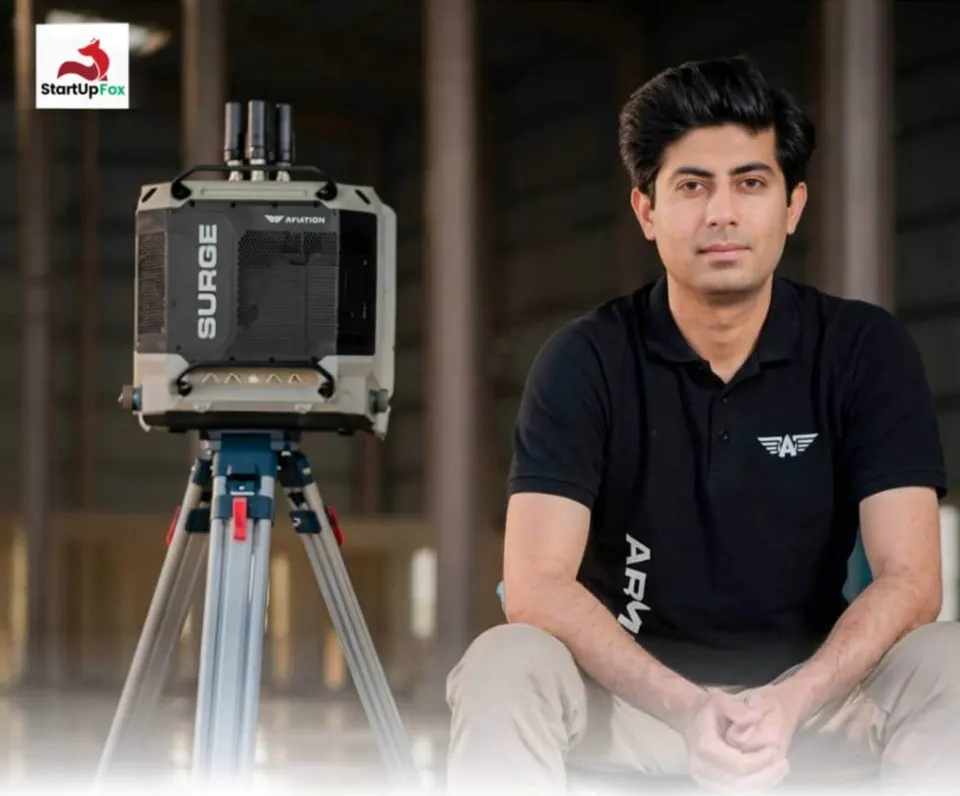
Gurugram-based defence technology startup Armory, founded in 2024 by Amardeep Singh, has secured a landmark ₹100 crore contract from the Ministry of Defence (MoD). The order mandates the production and widespread deployment of SURGE, the company’s indigenously developed Counter-Unmanned Aerial System (C-UAS). This deal arrives after rigorous, multi-terrain field evaluations where the hardware successfully detected and neutralized unauthorized rogue drones under extreme operational constraints. Operating as one of the youngest venture-backed firms to land a sovereign military contract of this magnitude, Armory plans to immediately use the capital to scale its Manesar manufacturing facility, expand its engineering workforce, and finance its next phase of hardware iteration.
Why It Matters
Armory’s fundamental advantage lies in how it tackles the modern asymmetric aerial threat. Legacy anti-drone hardware typically relies on fixed-frequency jamming, a rigid mechanism that frequently fails when commercial drones are weaponized and modified to communicate on non-standard channels. To solve this specific operational bottleneck, Armory engineered SURGE, an AI-enabled platform running on its proprietary Samaritan OS. Rather than brute-forcing airspace denial, the software scans environments millions of times per second, isolating irregular radio frequency (RF) signatures and updating its threat library in real time. This 'soft kill' approach allows military operators to jam or spoof a drone’s location, severing the connection to its controller without triggering physical destruction—a crucial requirement for sensitive or densely populated zones. Managing to build a field-ready system from scratch in 14 months points to incredibly lean R&D mechanics, driven by continuous feedback loops with on-ground forces rather than isolated lab testing.
The Strategic Read
At a macro level, this ₹100 crore procurement is a decisive indicator of how the Ministry of Defence is restructuring its capital acquisition strategy. Historically, major sovereign defense contracts were ring-fenced for massive public sector undertakings or established aerospace conglomerates with decades of tenure. Handing a tier-one contract to a startup barely two years old highlights a structural urgency within the government to prioritize deployment readiness, localized intellectual property, and functional agility over legacy brand names. With India’s defence budget expanding to ₹7.85 lakh crore in FY27, there is a clear mandate to reduce dependency on foreign imports and build a robust domestic supply chain. Armory’s rapid commercial validation opens the floodgates for institutional venture capital—which has already backed the firm with ₹35 crore in equity—to double down on critical infrastructure hardware. As Armory prepares to integrate physical 'hard-kill' capabilities into its future portfolio, it forces larger, slower defense firms to accelerate their product cycles, effectively turning agile startups into the new frontline of national security.
For daily, sharp analysis of the biggest moves in the Indian business and startup ecosystem, follow StartupFox.